Kubernetes Architecture

Kubernetes is a powerful platform for automating the deployment, scaling, and management of containerized applications. Its architecture consists of several components that work together to ensure the smooth operation of applications. Below is a description of the Kubernetes architecture along with a diagram.
Key Components of Kubernetes Architecture
Master Node: The master node is the control plane of Kubernetes, responsible for the global management of the cluster. It coordinates all activities within the cluster, including scheduling, cluster state management, and access control.
API Server (kube-apiserver): The API server exposes the Kubernetes API. All interactions with the cluster, including requests for deployments, scaling, etc., go through this component.
Scheduler (kube-scheduler): The scheduler is responsible for scheduling pods onto available worker nodes based on resource availability and other constraints.
Controller Manager (kube-controller-manager): This component runs controllers that are responsible for ensuring the desired state of the cluster is maintained (e.g., ensuring that a certain number of replicas of a pod are running).
etcd: A distributed key-value store used for storing all cluster data, including the desired state, configurations, and metadata.
Worker Node: Worker nodes are the machines (either physical or virtual) that run your application workloads. Each worker node contains several key components:
Kubelet: An agent that ensures the containers are running on the node and are in the desired state.
Kube Proxy: A network proxy that manages networking and load balancing for services within the cluster.
Container Runtime: The software responsible for running containers (e.g., Docker, containerd).
Pods: The smallest deployable units in Kubernetes, which are encapsulations of containers running together on a node.
Pods: Pods are the fundamental units of deployment in Kubernetes. A pod can contain one or more containers, and all containers in the same pod share networking and storage.
Services: Services are abstractions that define a set of pods and provide a stable endpoint (IP or DNS) for accessing them. They help in load balancing and service discovery.
Namespace: Namespaces provide a way to divide cluster resources between multiple users or teams. They enable better resource isolation.
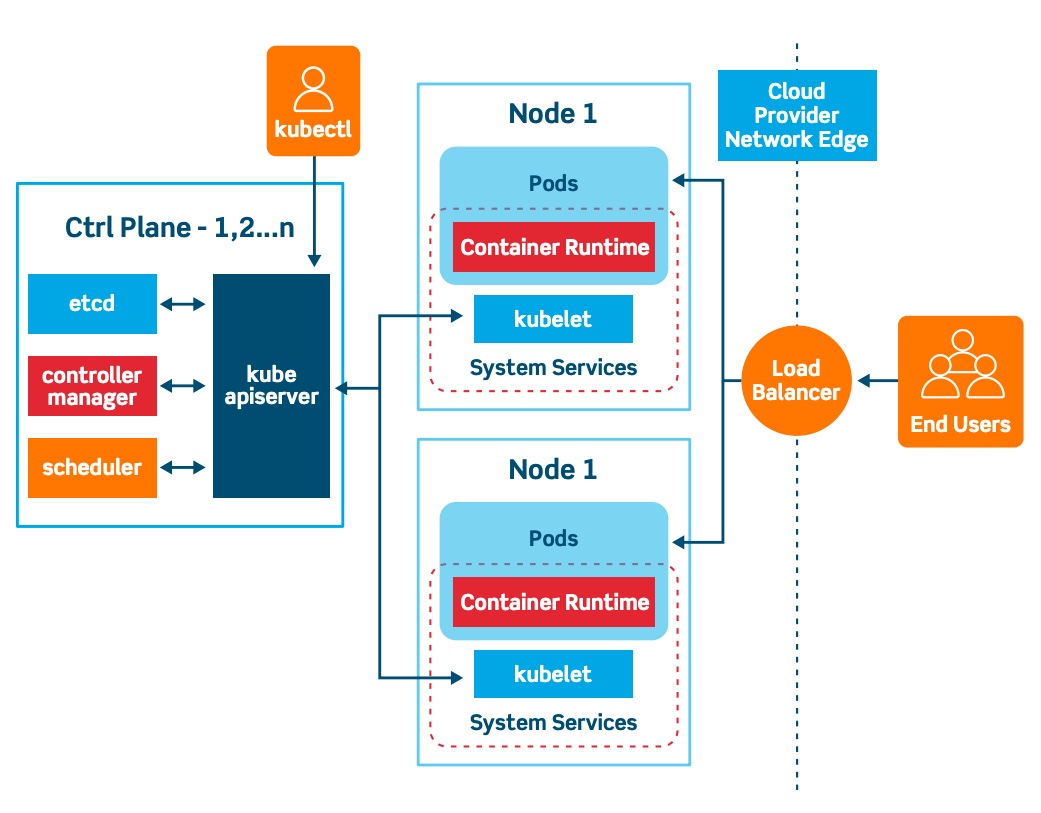
Architectural overview of Kubernetes
Explanation of the Diagram:
Client (kubectl): This is the user’s interaction point with the Kubernetes cluster, typically a command-line interface (CLI) or dashboard.
API Server: It handles incoming requests from clients and communicates with other components (Scheduler, Controller Manager, etc.).
Scheduler: The scheduler assigns pods to appropriate worker nodes based on available resources.
Controller Manager: It ensures that the cluster’s state is in the desired state, such as making sure the right number of pod replicas are running.
etcd: The distributed database that holds the state of the cluster.
Worker Node(s): These nodes run the application workloads in pods. Each worker node runs a kubelet, which ensures the containers are running in the desired state, and a kube-proxy, which manages networking for services.
Pod: The pod is the basic unit of deployment. It may contain multiple containers that share the same network and storage.
In this architecture, the Master Node is responsible for managing and orchestrating the cluster, while Worker Nodes host and run the application workloads.
Conclusion
Kubernetes architecture is a robust and efficient system for managing containerized applications at scale. By leveraging its key components, such as the Master Node and Worker Nodes, Kubernetes ensures seamless orchestration and management of application workloads. The Master Node acts as the control center, coordinating tasks and maintaining the desired state of the cluster, while Worker Nodes execute the application workloads within pods. With features like services for load balancing and namespaces for resource isolation, Kubernetes provides a comprehensive solution for deploying, scaling, and managing applications in a cloud-native environment. This architecture not only enhances operational efficiency but also supports the dynamic needs of modern software development and deployment.